
Beef shank soup: meat, broth and gelatin
Tender beef, root vegetables and a rich broth take time to come together. As beef shank simmers, the connective tissue in the meat changes too. Some of its collagen becomes gelatin and passes into the broth. 34
Collagen is also found in the connective tissue of beef shank, not just in supplements.
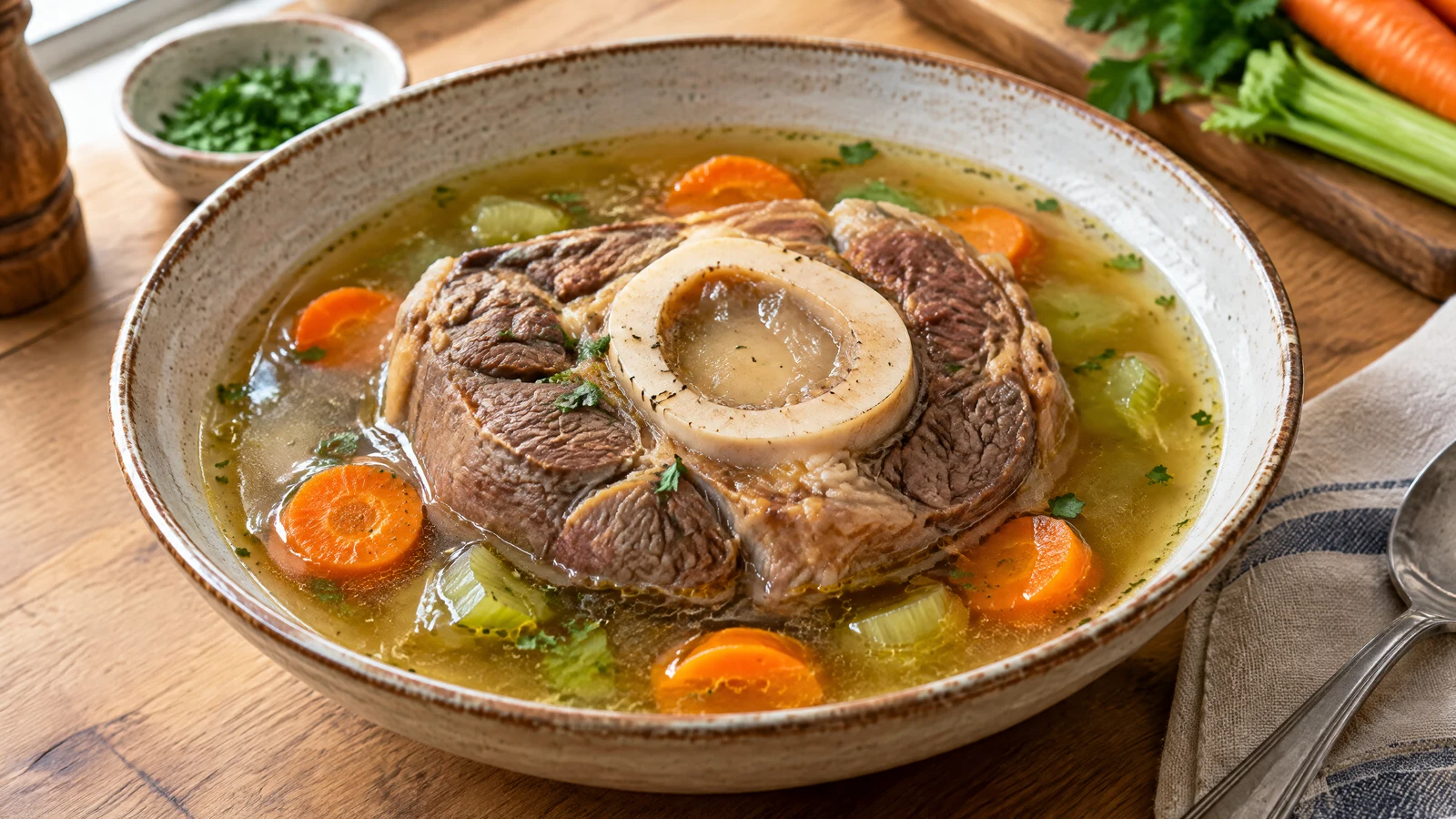
What happens as the meat simmers
Collagen helps give beef shank’s firm connective tissue its strength. During moist cooking, heat changes its structure so that some dissolves and becomes gelatin, while some collagen remains in the meat. How far this goes depends on the tissue and the way it is cooked. 34
Check for tenderness rather than relying on the cooking time alone: the meat should pull apart easily with a fork and come away from the bone. 15
Gelatin and collagen hydrolysate differ in how they are processed. Making a hydrolysate breaks the protein chains down further into smaller pieces. Many collagen studies use products made this way. Broth, by contrast, varies in composition according to its ingredients and preparation. 45
The meat contributes protein too
There is more to this soup than the liquid. Eating the cooked meat adds its protein to the meal. A USDA entry from 2018 lists approximately 34 g of protein per 100 g of cooked, separable lean beef shank. That figure applies to the meat described, not its weight with the bone or a whole serving of soup. 126
If you want to record the nutrition in a portion, weigh the cooked meat after removing it from the bones. Divide it between bowls or storage containers before adding the vegetables and broth. This avoids giving the first serving most of the meat by chance. Vegetables, broth and any marrow you eat are also part of the meal. Meat data alone does not describe these other components. 12
How much do the minerals in broth contribute?
A long simmer with bones tells you little about the mineral content on its own. Bone type, acidity and cooking time all affect what passes into the liquid. In a study of several bone broths, the average calcium and magnesium contributions were small compared with the reference intakes used. Simmering for longer does not, by itself, make soup a substantial source of minerals. 7
Suggested recipe: beef shank soup with root vegetables
Give the meat time to cook first. Add the carrots, celeriac and potatoes later so they do not fall apart during the long simmer. Use a fork to check the texture of both meat and vegetables towards the end. 15
Ingredients for four servings:
- 1 kg bone-in beef shank, cut into cross-cut slices
- 2 litres water to start, plus hot water for topping up
- 1 onion
- 300 g carrots
- 200 g celeriac
- 400 g potatoes
- 1 bay leaf
- 6 black peppercorns, preferably in a spice bag
- Parsley and salt to taste
You will need a large lidded pot holding about 6 litres, a sieve, tongs, a fork and a meat thermometer. This recipe contains celery. The amount of meat available for the four servings will be clear after cooking and removing the bones.
- Prepare the ingredients. Wash and trim the vegetables and parsley. Peel and halve the onion. Dice the carrots, celeriac and potatoes evenly, then refrigerate until needed. Check the shank slices for loose bone fragments and remove them with clean kitchen paper. Avoid washing raw meat. Clean your hands, equipment and work surfaces after handling it. Use clean utensils for cooked ingredients. 13
- Start the soup. Put the shank, onion, bay leaf and peppercorns in the pot. Add enough water to just cover the pieces. Add more water or choose a better-fitting pot if necessary, leaving plenty of room below the rim. Bring to the boil, then turn the heat down to a gentle simmer. Set the lid slightly ajar. Check the liquid level now and then and top up with hot water as needed.
- Cook the meat until tender. Allow approximately two and a half to three hours. Thicker or tougher pieces may need longer. Towards the end, check with a fork that the meat separates easily and comes away from the bone. Keep cooking if it is still firm. Also check the food-safety temperature: every part of the meat must reach at least 70 °C for two minutes during preparation. Measure in the thickest part without touching the bone with the probe tip. 1513
- Remove the bones. Lift out the shank with tongs. Strain the broth through a fine sieve into a clean pot. Remove the bones and any firm parts you do not intend to eat. Break the meat into bite-sized pieces. If you are using nutrition data for cooked meat, weigh the meat at this point. Record any marrow you eat separately.
- Cook the vegetables. Add the carrots, celeriac and potatoes to the broth. Simmer until a fork goes into them easily. Start checking small dice after approximately twenty minutes. Return the meat and heat the whole soup thoroughly. Every part must reach at least 70 °C for two minutes. Remove the spice bag if used, then season with salt and parsley. 1513
- Divide the soup. Distribute the meat between four bowls or suitable storage containers first, then add vegetables and broth. A fixed protein or calorie figure per serving would require the actual edible yield. The ingredient list alone does not provide that.
What to do with leftovers
A large pot of soup cools slowly. Divide leftovers straight away between several shallow containers, rather than leaving the pot on the stove overnight. A cold-water bath helps the containers cool faster. Keep the water out of the soup. The German Federal Institute for Risk Assessment recommends cooling cooked food below 7 °C within a few hours. Refrigerate covered leftovers at no more than 7 °C, preferably below 5 °C, and use them within two to three days. Check the temperature with a thermometer. 1314
For later meals, freeze individual portions after cooling them promptly. Thaw the soup in the fridge where possible. Reheat only the amount you need, stirring so that every part reaches at least 70 °C for two minutes. Boiling again does not reliably destroy heat-stable bacterial toxins that may already have formed. 1314
Collagen, skin and joints: what has been studied?
Reading about collagen soon brings you to studies on skin and joints. The first question is what the participants actually consumed. Gelatin, collagen hydrolysate and soup differ in composition.
A small study involving nine healthy women aged 20 to 22 tested gelatin made from fish skin. Afterwards, short collagen-derived fragments were detected in blood, including Pro-Hyp and Hyp-Gly. Each consists of two amino acids. The study measured their uptake into blood, rather than changes in skin or joints. 4
For skin, the picture is mixed. A trial involving 69 healthy women aged 35 to 55 reported differences in skin elasticity after eight weeks with a specific collagen hydrolysate. Overall group comparisons for hydration, water loss and roughness were not significant. 8 A 2025 review found positive results in its overall analysis. However, no significant effects appeared in studies classified as high quality or in the subgroup without pharmaceutical company funding. 9
For joint discomfort, a 24-week study tested a collagen hydrolysate in physically active university athletes with activity-related discomfort and no evidence of joint disease. Of 147 randomly assigned participants, data from 97 were analysed. Several pain scores differed from placebo. The outcome measured was discomfort, not cartilage growth. 10
These studies address particular gelatin and peptide products. They did not test whether beef shank soup would produce the same results. The often-mentioned soup experiment on immune cells is also a different case: it tested chicken soup and cell movement in a laboratory, rather than beef shank soup or infection rates after eating it. 12 Normal immune function requires an adequate supply of several nutrients. Diet as a whole contributes to that supply, rather than one dish in isolation. 11
For a separate look at topical skincare, see Retinol and retinoids: understanding skin ageing.
Cook once and prepare several meals
Beef shank soup can be divided into individual meals. Meal prep for training days explains how to organise cooking ahead. If time is short, High-protein dinner after work offers quicker alternatives.
The 8 Protocol lets you record the foods and amounts you eat. This meal includes the cooked meat removed from the bones, vegetables, broth and any marrow you choose to eat. Bone weight is not part of the meat eaten.
Context: This article explains a food, its preparation and selected research. It does not replace individual medical or nutritional advice.
Sources
- USDA: Protein, Standard Reference Legacy (2018). Reference food: cooked, separable lean beef shank. The full specification is “separable lean only, trimmed to 1/4 inch fat, Choice, cooked, simmered”. Meat classified as lean still contains intramuscular fat and edible connective tissue. This is not a nutrition figure for bone-in shank or the soup recipe.
- USDA: Retail Beef Cuts, Release 2.0 (2011)
- Latorre and Velazquez: Thermal treatment of bovine connective tissue (2021)
- Iwasaki et al.: Gelatin and gelatin hydrolysate ingestion (2022)
- Alcock et al.: Amino acid concentrations in bone broth (2019)
- NIST: SP 1020 (2020). Mass conversion: one ounce equals 28.349523125 g. The USDA table lists 28.63 g of protein per 3 oz of the specified cooked meat. Rounded, that is 34 g of protein per 100 g.
- Hsu et al.: Essential and toxic metals in animal bone broths (2017)
- Proksch et al.: Specific collagen peptides and skin physiology (2014)
- Myung and Park: Collagen supplements and skin aging (2025)
- Clark et al.: Collagen hydrolysate in athletes (2008)
- NIH Office of Dietary Supplements: Immune Function
- Rennard et al.: Chicken soup and neutrophil chemotaxis in vitro (2000)
- BfR: Lebensmittelinfektionen im Privathaushalt (2024)
- BfR: Korrektes Kühlen im Privathaushalt (2023)
- Rutabaga soup with beef shank, accessed 4 November 2026. Recipe comparison for the cooking sequence and times.